How Practical Founders Are Surviving the AI Hype Cycle
Updated: Apr 26
For more than a decade, the SaaS startup playbook was reliable and repeatable. Build software. Raise venture capital. Scale sales and marketing. Grow ARR. Defend gross margins. Repeat. AI has not erased that model, but it has forced SaaS businesses to update their default settings.

Software is getting faster and cheaper to build. Buyers increasingly want software that doesn’t just create work — they want software that does the work. Capital is flowing more aggressively toward a narrower group of breakout AI companies. And go-to-market, which was never easy, is even less forgiving.
Amid the recent flight from public SaaS stocks and the constant drumbeat of “AI is eating SaaS,” there’s an important story that’s being overlooked about practical SaaS founders who are still in the game. These operators building steady-growth software companies — with AI and without venture backing — may not project main character energy, but they can certainly survive the hype cycle.
That is the frame Greg Head, founder of Practical Founders, gives this moment:

“From the bootstrapped SaaS founders I work with, I see most founders making solid progress with AI in the last 6 months. You don’t need big VC funding to benefit from serious efficiency gains in development and GTM. And innovative founders are rethinking new ‘systems of action’ apps with AI that work with their existing systems of record products.”
Head is a successful software veteran with over 30 years of experience. Today, he’s a strategic advisor to SaaS founders building software companies without big funding, the host of the Practical Founders podcast, and a top voice on LinkedIn.
Head has a unique understanding of AI’s meteoric rise and the corresponding SaaS evolution that’s underway.
Faster product development, tougher GTM, new pricing pressures, and a narrower VC market may present formidable challenges for modern SaaS businesses, but Head believes that practical founders still have a path to durable growth — and a distinct advantage over newer AI-native companies.
We spoke with Greg Head to understand where SaaS is today, and how founders are adapting the growth playbook to build a moat for the future.
Here's what we cover:
The convergence of SaaS and AI: From systems of record to systems of action
Venture capital’s lust for AI and extraordinary outcomes: VC doesn’t care that you doubled revenue
More startups, fewer winners: The gains from AI are not evenly distributed
Selling outcomes instead of access: Pricing must evolve with the product
Doubling down on practicality: The rise of the AI-native bootstrapper
Adapting the SaaS Growth Playbook
1. From systems of record to systems of action
SaaS and AI are converging. Sticky software delivers more than AI features — it’s capable of executing work inside the workflow.
That broader transition is showing up in the data. McKinsey’s 2025 State of AI found that 88% of respondents say their organizations now use AI in at least one business function, but only about one-third say their companies have begun scaling AI programs. OpenAI’s The State of Enterprise AI report adds another layer: 75% of workers surveyed said AI helps them complete new tasks they previously could not perform.
It’s evidence that backs up Head’s point on “systems of action.” The opportunity is no longer just to sell a better dashboard. It is to build software that helps customers execute, decide, resolve, qualify, analyze, and complete work.
AI isn't purely a greenfield opportunity for brand-new startups, either. Existing SaaS companies that already sit inside important workflows may be better positioned to win in their markets and they deserve far more credit than they’re getting at the moment. Menlo Ventures reported that 64% of customers preferred buying from established vendors, citing trust, security, and out-of-the-box functionality. More on that shortly.
2. VCs don’t care that you doubled revenue
AI has clearly intensified capital concentration. Carta’s State of Startups 2025 says AI startups captured 44% of all US startup capital. Additional data from WIPO explains why the market feels so lopsided: global VC deal values rose, but deal counts kept shrinking, and AI-related megadeals drove a growing share of the total. WIPO said an estimated 9,400 deals were made in Q3 2025, the lowest level since 2020. In other words, more venture funding is flowing into fewer companies.
Bessemer Venture Partners admits, “What constituted a great startup in the SaaS era doesn’t quite cut it anymore.”
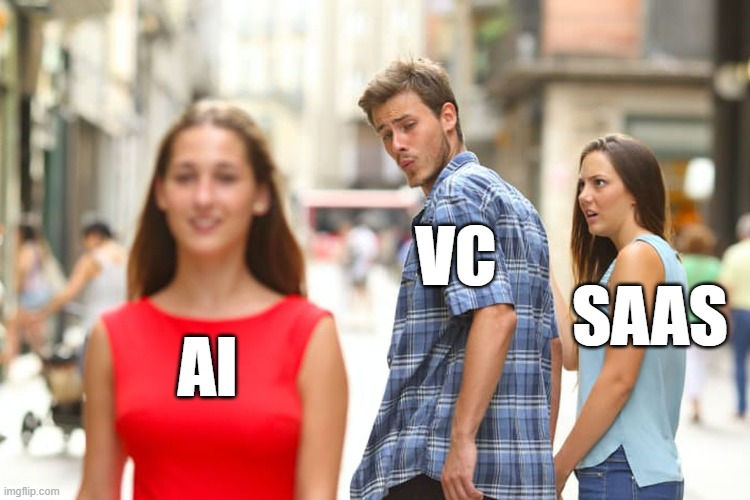
Head cautions against using VC appetite as a barometer for business value and viability:
“Venture funding in the US is almost exclusively focused on the big LLM platforms and the hyper-growth AI apps. Even 100% growth is not interesting to VCs now. But practical software founders can find other ways to self-fund their startups and efficiently fund growth if they need small doses of extra capital.”
Where do founders get extra capital?
While we mostly only hear about venture-backed unicorns, only a tiny fraction of them will reach a successful exit. That leaves a large number of viable tech businesses trying to survive and thrive in this new environment.
Founders working to keep up have a lot on their plates: integrate AI, invest in distribution, and keep an eye on other fast-moving startups in their space. How do they persevere if raising VC isn’t an option and a little extra capital is needed to push ahead?
Practical founders combine several approaches to extend runway:
Option 1: Build a defensible moat
Lower barriers to entry mean new competitors can appear quickly. Many investors now emphasize hyper-vertical SaaS as a durable competitive strategy. Successful companies increasingly rely on:
Proprietary data
Vertical specialization
Workflow integration
Brand and trust
Option 2: Leverage AI agents for product and GTM
AI can dramatically improve both product capabilities and internal operations, enabling companies to move faster with fewer employees.
Option 3: Self-fund growth from revenue
Though it's not new, it's still an effective strategy for growing a SaaS business. Build an MVP, find product-market fit, build up a loyal customer base, and expand from there. The SaaS model is ideal for reinvesting revenue to reach sustainable growth.
Option 4: Use non-dilutive funding
Revenue-based financing and other non-dilutive funding options are increasingly attractive to founders looking to accelerate growth, without giving up equity or ownership. Lighter Capital data shows the demand for non-dilutive funding doubled last year — the annual growth rate of new financing opportunities jumped from 4.8% in 2024 to 9.1% in 2025.
Head says non-dilutive funding has become a familiar part of the modern capital stack.
“Non-dilutive funding for bootstrapped SaaS companies was very new 10 years ago. Now most founders know it’s available and are starting to learn which forms of non-dilutive funding work in which situations.”
3. The gains from AI are not evenly distributed
From the outside, it looks easier than ever to start a SaaS business because AI has compressed the time and cost to build. Of course, the hard part was never just building software. To win, startups still have to earn attention, trust, and long-term market position, which only gets tougher in increasingly competitive markets.
And there's the rub. AI may generate an influx of new startups, but ultimately, there will be fewer winners.
Stripe Atlas reports that 42% of founders identified as building AI startups in 2025, up from 15% in 2023. The same reports says founders are monetizing faster, with the median first six months of revenue for the 2025 cohort up 39% year over year. At the same time, only 2.2% of Atlas startups had fundraised within three months of incorporating, down from 3.1% in 2024.
So yes, more founders are starting AI companies. Yes, they are getting to revenue faster. And yes, fewer are getting funded early.
Welcome to entrepreneurship in 2026: more competition, more bootstrapping, more pressure to prove something before outside capital shows up.
Interestingly, Lighter Capital data shows a big spike in average growth rate for companies in the $10M+ ARR range (62.8% growth) compared to smaller startups. Last year we observed annual growth accelerate in startups making over $5M ARR, while growth rates slowed from prior years in startups below $5M.
Does that mean we are starting to see a 'winner-takes-most' consolidation, where established players are successfully adapting their businesses to AI? Not necessarily.
Head had a more nuanced take on the current environment.
“In the early stages from startup to $20 million, it’s still very sector specific and founder specific. Some markets and industries are moving faster with AI adoption than others. And some founders are making more practical progress with AI than others. You don’t want to be too far ahead of your market, but you don’t want to be left behind when the shift happens.”
Steady-growth SaaS businesses do have an advantage over new AI-first startups and others just coming to market.
Head explained, “Existing software companies have established relationships with customers and partners. Sales and marketing are still the harder part of the growth game. And having deep knowledge and deep data are still advantages, especially in vertical markets.”
4. GTM is still the hard part
There is one thing that remains consistent: go-to-market is what makes or breaks a valuable software company.
“GTM tactics, buyer preferences, and category definitions are shifting quickly,” Head noted. “There’s still no easy playbook for getting attention and conversion, which makes VC funding less useful than ever. Practical founders find efficient tactics they can expand on in smaller bets.”
Lighter Capital’s 2025 SaaS Benchmarks Report shows GTM isn’t just hard — it’s getting harder.
Median sales and marketing efficiency for private B2B SaaS startups fell from 6.08x in 2024 to 3.19x in 2025. Public market data show similar challenges: Blossom Street Ventures found the median S&M efficiency across the last 20 SaaS IPOs was $0.66 — meaning the typical public SaaS company generated only $0.66 of new revenue for every dollar of marketing spend.
GTM strategies have to adapt to a buyer journey that starts earlier, touches more channels, and demands more evidence. Put bluntly, “AI-powered” is not a moat. At this point it barely counts as an adjective.
Established SaaS businesses certainly have a head start here, but clever, authentic messaging that connects with target audiences where they’re at — that’s really anyone’s game.
5. Pricing has to evolve with the product
The “token economics” of AI is also forcing a deeper pricing rethink. Seat-based SaaS pricing made sense when usage and value scaled loosely with headcount. That becomes harder to defend when one user can trigger thousands of AI tasks, compute costs fluctuate, and the real value ultimately lies in completed work.
Our recent SaaS pricing analysis makes that point directly: AI changes both the cost structure and the value model of software, pushing more companies toward usage-based or outcome-based pricing as AI becomes more embedded in the product.
Head’s framing is sharper still: “AI products that consume expensive tokens tend to do work that was done by people before, or that was too expensive to be done by people. So they can charge for execution results (outcomes) vs. users/seats, which was always a false proxy.”
6. The rise of the AI-native bootstrapper
While it’s never been easier to start a software company, it’s much harder to build a durable one. The takeaway for founders isn’t to chase the AI hype — it’s to adapt the growth playbook with an AI-first mentality.
That playbook looks even more practical. More capital-efficient. More focused on compounding advantages that new entrants to the market cannot copy overnight.
“VC funding has basically abandoned pre-revenue and steady growth companies, so we’re back to fund it yourself to get it going, spend less than your revenues (customer funding), and be very practical about capital if you think you need it to accelerate growth. You don’t need outside funding to start a software company these days,” Head said.
With AI, founders can do more with smaller teams and smaller budgets. But those advantages are being offset by AI in other ways: more competition, higher expectations, and capital concentrating into fewer hyper-growth companies.
For bootstrapped SaaS startups the path forward is still very real, but it looks different:
Move faster with AI, without sacrificing defensibility
Invest in sales and marketing as aggressively as product
Treat pricing and margins as strategic levers, not afterthoughts
Use capital strategically — whether from revenue, investors, or non-dilutive sources — with laser-focus on efficiency
Head had some final practical advice for the practical founder:
“The efficiencies that AI enables are generally freeing more capital for other projects. And some of those experiments that work can be funded very efficiently now. So it’s all about finding something that works and having confidence that doing more of it will work too.”